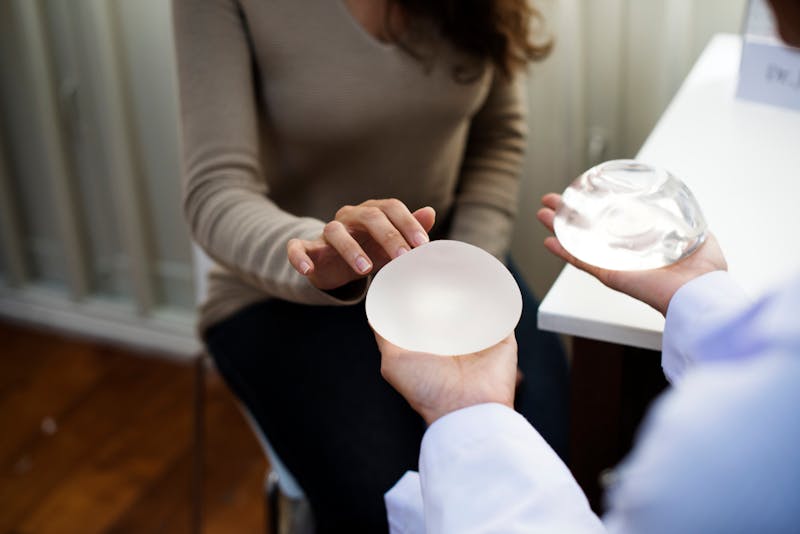

TransDifferentiating the variety of breast implants on the market for women in Houston can be a challenge given the many types and varieties there are to choose. We regularly discuss those differences in the products we use for our patients' needs here at our blog post. Today, we will focus solely on the appearance, safety, and benefits of breast implants that have valves.
Valves have changed over the years of breast implant augmentation surgeries. A few types of valves (like the leaf valve, not often used in today's implants) have nearly been phased out of production given issues of trauma or reoccurance of malfunction. Other breast implant valve types are the the kink valve and the diaphragm valve. It is significant to mention that none of these valves are found on gel silicone implants. They are found on saline implants and they allow the doctor to adjust the fluid content in the breast when trauma occurs to the implant.
These valves types are primarily self-sealing and close automatically when the fill tube is removed--the most common variety being the diaphragm valve. Additionally, there is a small plug that covers these valves. This plug serves only to cover the site and reduce the risk that tissue will grow into the valve and possibly damage it or cause skin discomfort or irritation.
Still, even with these safety devices in place, to those particularly thin individuals, the valve may sometimes be confused with a small mass or like a lump in the breast. The valve may have become palpable by shifting or caused mild subcutaneous scarring. This happens especially with sub-glandular placement (over the muscle).
Typically those that may encounter this problem are individuals with less sub-glandular breast tissue pre-operative and those with low body fat or those who are thin-skinned. For the majority of individuals with regular skin types, this rarely occurs and is generally not an issue. Given the reduction in saline leakage and the switch by manufacturers to more dependable valves like the diaphragm valve, the patient has seen a reduction in these issues occurring. However, if you are a woman with breast implants in Houston who has recently discovered a lump in the breast, contact your doctor immediately for evaluation. Only they will be able to clarify for sure the difference between valve scarring and something that may have more serious ramifications.
Ask your doctor which type of breast implant suits your needs and body type. If you decide to choose a saline implant, determine what model type with valve variety is best for your body type and method of surgical insertion.
In a world focused on mass-production lead by the drive of society's focus on "bigger is better," we have the tendency to apply these same ideals to even the most personal of perspectives. This is never so true than in the ideals of personal image and cosmetic surgery. Typically, this has proven to be the case for breast implant surgery for many individuals--with the tendency skewed toward more extreme looks in our figures.
Psychologists have completed many decades of studies on self-perception, and often see these skewed self-perceptions in the general populous. Everyone has experienced this at one time or another in their own lives. Much like the unfamiliarity of your own voice being played back to you in a recording, given perspective, individuals usually have to use new reference points to accept their own features.
In many ways a cosmetic surgeon completes this task of mediating a patient's perception of themselves with a focus on their outside perspective. The option of sizing down a breast implant surgery is usually a good idea when speaking with your doctor. Often women ask for the maximum size possible during their consultation. They typically want to overcompensate based on a skewed perception of inadequacy. Rather than over accentuating the feature, finding a mid-sized range of implant can result in a much more eye-pleasing figure proportionate to the total body. This results in a greater aesthetic result post-surgery with the woman's overall figure in mind rather than a disproportionate look of being to "top-heavy."
So before going "big" ask yourself, "Is 'bigger' really better?"
Individuals considering breast implants often ask about the durability of the saline implant. These devices are not “lifetime devices” and though you may possibly never have a problem regarding the use of your implants, the average expectancy for failure of a device is around 10 to 15 years.
Studies indicate that problems for these saline devices occur at a rate of around a 1% increase in possible failure per year of wear.
Deflation is when a saline implant leaks and the fluid is absorbed by the body. Unlike gel implants, deflation in saline is quite apparent. If this were ever to occur you should schedule an appointment immediately, but should know you are not in danger. This rarely happens and may never happen over the course of the of the breast enhancement device.
Because saline is a non-harmful solution that is readily absorbed by the body, the FDA does not specifically suggest regularly schedule MRIs for saline as opposed to gel. MRIs should, however, be considered a part of any woman’s yearly physical check-up over the age of 30 and beyond—especially those at risk. Overall, an excellent breast augmentation device, but ultimately up to the decision you make with your doctor.
Youthful aspirations to be beautiful are a natural part of the process of the individual development of a teenager. However, when a teenager begins to ask for plastic surgery and does not have a medical issue affecting their quality of life, there may be more serious underlying emotional issues. These risky ideas often mask more serious issues like body dysmorphic disorder.
Chronic mental illnesses such as these can give rise to a growing obsession of your appearance. The individual focuses regularly on a real or imagined flaw that they perceive as a serious deformity. Both nature and nurture are to blame for this disorder and this can take quite a bit of therapy to overcome.
Teenagers need to be aware that by changing their body with a breast implant, liposuction, or rhinoplasty, they aren’t going to change their mental condition. Individuals with this mental issue will still have a problem obsessing over their body, and often find new “flaws” they want surgically treated.
Surgery is a process that only affects the individual’s body, not their genetic composition or what makes them who they are in spirit. An alteration though plastic surgery won’t change these traits in their body or mind and they may still appear in their children when they grow up to raise their own family. Nothing is truly eliminated by a plastic surgery. Speak with your child if they are expressing unhealthy fascination with breast implants, mentioning liposuction when complaining about their weight, or suggesting a nose job if they don’t have sinus conditions. They deserve to know they are beautiful for who they are not just how they look.
Individuals expressing their desire for cosmetic and plastic surgery seem to be getting younger and younger. Perhaps it is the age in which we live, where we are bombarded by sensory image and sound that can have profound effect on our perceptions of our own bodies. Younger individuals are expressing themselves more and more with tattoos and body alterations. It is healthy to be individual and define ourselves as who we are and what we want for ourselves in the future.
However, younger individuals need to take a much harder look at themselves before turning to plastic surgery for solutions. We won’t treat just any whim of a person no matter how young to resolve issues that may be more personal or emotional. Cosmetic Surgery has its purpose in medical study and its development over the years have been founded on the same principles that hold true to our medical standards guided by Hippocratic Oath.
If a young individual is diagnosed with an issue that interferes with their health and enjoyment of life to an extent deemed worthy for operation, then a voluntary surgery may be performed. Plastic surgery treats real issues. Liposuction may be used to offset secondary medical issues like diabetes. Inhibited breathing may be alleviated with the surgical procedure of rhinoplasty, and so on.
The potential for physical development through diet exercise and natural growth is simply too great to resort to surgery at too formative of a phase in a young woman or man’s life. If a youth is interested and does not have an issue threatening the quality of their life, we recommend the individual wait and possibly seek help.
Page 1 of 70
Inquiry about a Procedure
Please take a moment to contact the practice with the form provided:
|
Differentiating the variety of breast implants on the market for women in |
|
In a world focused on mass-production lead by the drive of society's focus on "bigger |